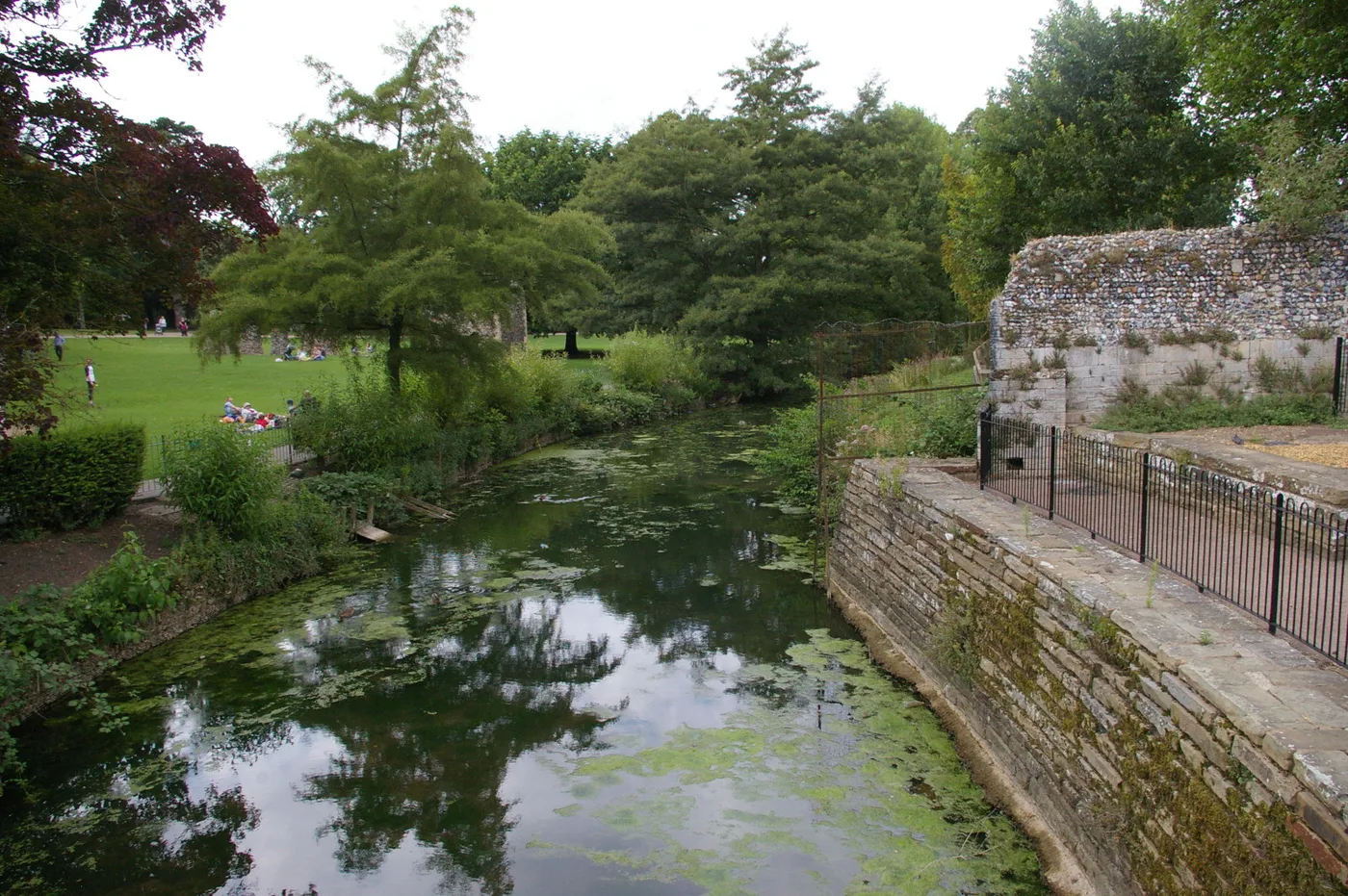

The Lark at Fornham St Martin is running at under a third of its August average, lower than all but five Augusts since 1985. The hosepipe ban has no end date.
The River Lark has been running at less than a third of its normal August level through Bury St Edmunds this month, and the hosepipe ban that covers the town is still in force with no end date attached to it.
The Environment Agency’s gauge at Fornham St Martin, which measures the Lark on the northern edge of the town and drains a catchment of 110.2 square kilometres, recorded a mean flow of 0.032 cubic metres a second across the first 13 days of August. The long run average for August at that gauge is 0.104 cubic metres a second, calculated from the 39 Augusts in its record between 1985 and 2024. (Environment Agency hydrology data, Fornham St Martin; National River Flow Archive, station 33070)
Only five Augusts in that record ran lower: 1991 and 1997, both at 0.011, then 1990 at 0.017, 1992 at 0.019 and 2019 at 0.021. Two things are worth saying plainly about that comparison. This month’s figure covers 13 days rather than a full month, and the daily readings behind it are still marked “unchecked” by the Environment Agency, which means they are provisional and can be revised.
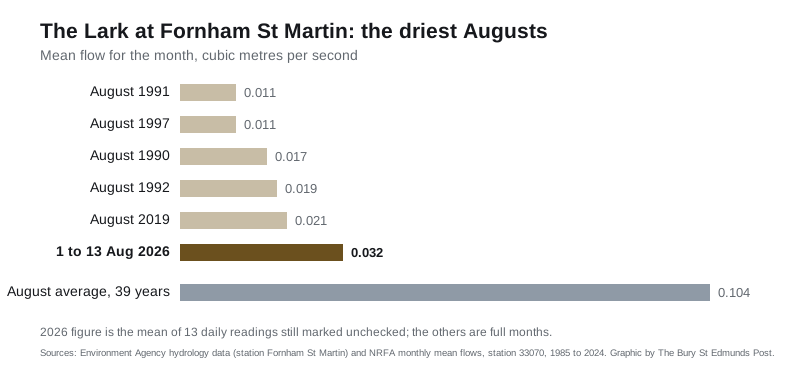
The flow is now close to the gauge’s Q95, the level exceeded 95 per cent of the time and the standard marker for a very low river. At Fornham St Martin that is 0.022 cubic metres a second. (National River Flow Archive, station 33070)
What the Environment Agency said this week
East Anglia remains formally in drought, with no change in the week to 13 August. England received 6 per cent of its long term average rainfall for August up to that point, reservoir storage across the country fell to 65.9 per cent, and 71 per cent of England by land area is now in drought. (Environment Agency, dry weather and drought in England, 7 to 13 August 2026)
Farming is being restricted alongside households. There are 1,544 restrictions on abstraction licences nationally, and formal section 57 restrictions came into force in parts of East Anglia on 10 August, running to 31 October, cutting 288 spray irrigation licences by half to protect exceptionally low river flows. A further 192 voluntary abstraction restrictions are in place across East Anglia. (Environment Agency, 7 to 13 August 2026)
The same report lists Anglian Water at drought level 2 in its Fenland and its Norfolk, Norwich and Broads water resource zones, and at drought level 1 in Ruthamford, Lincolnshire and Suffolk. Temporary use bans remain in place across the whole company area apart from Hartlepool.
West Suffolk Council pointed at the same conditions on 11 August, when it set out its environmental work for the year. Councillor Janne Jarvis, the ward member for Newmarket North who proposed the motion behind it, said “the drought and devastating fires we have seen here in Suffolk demonstrates why environmental resilience matters”. (West Suffolk Council, 11 August 2026)
The ban that applies in Bury St Edmunds
Anglian Water is the water company here. It was the consultee on foul water capacity for the Rougham Hill supermarket approved this month (officer report, appendix A, paragraphs 192 and 193), and the council’s own sustainability officer called this “an area of serious water stress” in the report that went with it (report DEV/WS/26/025, paragraph 4.5). Check the name on your bill: if it says Essex and Suffolk Water, a separate ban applies to you, in force since 3 August.
Anglian Water’s temporary use ban started at 01:01 on Saturday 11 July and, in the words of its own statutory notice, “will continue until further notification”. It covers the whole supply area other than Hartlepool. Breaching it is an offence, and on summary conviction carries a fine of up to £1,000. (Anglian Water, statutory notice for temporary use ban, version 3, 17 July 2026)
Eleven uses of a hosepipe are prohibited: watering a garden, cleaning a private car or trailer, watering plants on domestic or other non-commercial premises, cleaning a private leisure boat, filling or maintaining a domestic swimming or paddling pool, drawing water for domestic recreation such as a hot tub, filling or maintaining a domestic pond, filling or maintaining an ornamental fountain, cleaning the walls or windows of a home, cleaning paths or patios, and cleaning other artificial surfaces.
“Hosepipe” is defined widely. Sprinklers, irrigation systems and anything attached to a hose, including pressure washers, all count, and so does filling a container from a hose. “Garden” includes lawns, grass verges, parks and non-commercial allotments.
What it means for you
Almost everything on that list is still allowed with a watering can or a bucket, and the two exceptions are filling a pool and filling an ornamental fountain. Water that does not come from the mains, so a water butt, harvested rainwater, grey water or a private borehole, is outside the ban entirely, and a hosepipe connected to a water butt is not restricted.
Growing food is treated differently. A hosepipe may be used on food crops, including fruit trees, at home or on a private allotment where that cannot reasonably be done with a watering can. The same allowance covers saplings, trees, whips and hedging planted within three years of the ban starting, newly laid turf for its first 28 days and newly sown grass seed for its first 28 days. A drip or trickle system may run if it has a pressure reducing valve and a timer, is not handheld and puts water onto the soil without spray or runoff.
If a health condition, disability or support need means you cannot safely use a watering can, the ban does not apply to you and you do not have to apply or notify anyone. Customers on Anglian Water’s Priority Services Register are covered automatically, and people who are not registered but would be eligible, including some Blue Badge holders, are covered too. The register is at anglianwater.co.uk/priority-services.
Hosepipe use for animal welfare and for unavoidable health and safety reasons is not restricted, and a business that washes customers’ cars as a service may use a hosepipe where a bucket will not reasonably do.
We will update this page when the ban changes. The weekly Environment Agency drought briefings are published on GOV.UK, and the Lark’s flow at Fornham St Martin is public data that anyone can check.
Have your say