
Bury St Edmunds council tax runs from £1,525.92 in band A to £4,577.76 in band H for 2026/27, with band D at £2,288.88. Checked November 2026.
Bury St Edmunds council tax bands run from A to H, and a band D property pays £2,288.88 in 2026/27. That is £104.01 more than last year, a rise of 4.76 per cent.
West Suffolk Council publishes the full band A to H table, but only as a scanned public notice with no readable text in it. Here it is typed out.
Bury St Edmunds, band A to H, 2026/27
| Band | Charge for the year | Per month over 10 instalments |
|---|---|---|
| A | £1,525.92 | £152.59 |
| B | £1,780.24 | £178.02 |
| C | £2,034.56 | £203.46 |
| D | £2,288.88 | £228.89 |
| E | £2,797.52 | £279.75 |
| F | £3,306.16 | £330.62 |
| G | £3,814.80 | £381.48 |
| H | £4,577.76 | £457.78 |
The annual figures come from the council’s notice of setting of Council Tax for 2026/27, approved on 24 February 2026. The monthly column is our own arithmetic. Bills are payable over ten instalments by default, and you can ask to spread them over twelve instead.
One warning. The council’s own Council Tax advice
page tells
you to check “West Suffolk Council Tax rates” and links to a file called
2020-21-Council-tax-rates.pdf. That link still works, and still serves the
rates from six years ago. Ignore it.
What makes up the bill
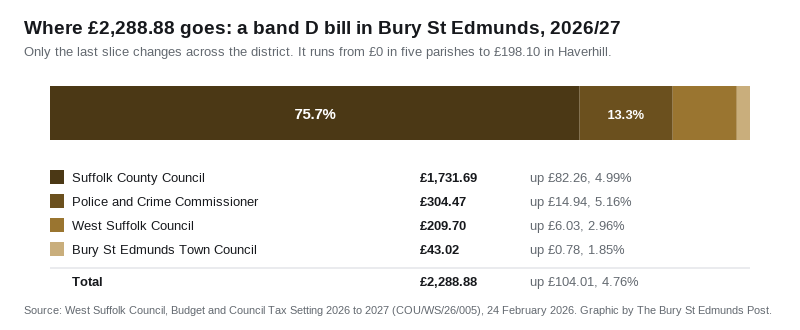
Four authorities take a share. Three of them charge the same across the whole of West Suffolk; only the last varies.
| Authority | 2025/26 | 2026/27 | Change |
|---|---|---|---|
| Suffolk County Council | £1,649.43 | £1,731.69 | up 4.99% |
| Suffolk Police and Crime Commissioner | £289.53 | £304.47 | up 5.16% |
| West Suffolk Council | £203.67 | £209.70 | up 2.96% |
| Bury St Edmunds Town Council | £42.24 | £43.02 | up 1.85% |
Those figures are all band D, and come from West Suffolk’s own budget and council tax setting report.
The county council takes 73.6 per cent of everything collected in West Suffolk, £105.27 million of the £142.95 million total. Its 4.99 per cent rise is the legal maximum without a referendum and splits two ways: 2.99 per cent for general services and 2 per cent as the adult social care precept. Suffolk councillors approved it on 12 February 2026.
The police precept went up by £14.94, or 5.16 per cent, after the Suffolk Police and Crime Panel backed the higher of two options on 30 January. The panel voted 8 to 1 in favour, with one abstention. The alternative on the table was £9.99. The decision paper sets out both.
West Suffolk Council itself takes 8.9 per cent, and put its share up by £6.03.
Bury pays less than its neighbours
The parish or town precept is the only part of the bill that varies inside West Suffolk, and Bury St Edmunds Town Council charges one of the lowest in the district. Its precept spreads £646,090 across a tax base of 15,017.98 band D equivalents, by far the largest tax base in West Suffolk, which is why the per-household figure comes out so low.
| Town | Town precept, band D | Total band D bill |
|---|---|---|
| Bury St Edmunds | £43.02 | £2,288.88 |
| Mildenhall High Town | £163.41 | £2,409.27 |
| Brandon (and Wangford) | £166.23 | £2,412.09 |
| Newmarket | £189.96 | £2,435.82 |
| Haverhill | £198.10 | £2,443.96 |
A band D household in Haverhill pays £155.08 a year more than one in Bury St Edmunds, for the same county, police and district services.
Five parishes charge no precept at all, so their band D bill is £2,245.86: Ampton, Timworth and Livermere; Barnardiston; Higham; Little Bradley; and Little Wratting. The highest single-year increase among the towns was Newmarket, whose band D precept rose from £173.17 to £189.96, up 9.7 per cent.
The district average parish charge is £105.61 at band D, up from £100.37. The council’s own leaflet says parish bills range “from nil to £1698.10”, which is a typo: the highest is Haverhill’s £198.10.
What each Bury St Edmunds council tax band means
Council tax bands in Bury St Edmunds are the same eight letters used everywhere in England. Each letter covers a range of what the home would have sold for on 1 April 1991, set in section 5 of the Local Government Finance Act 1992, and each band is a fixed fraction of band D. That is why the charges in the table above move in step:
| Band | 1991 value | Share of band D | Bury St Edmunds, 2026/27 |
|---|---|---|---|
| A | up to £40,000 | 6/9 | £1,525.92 |
| B | £40,001 to £52,000 | 7/9 | £1,780.24 |
| C | £52,001 to £68,000 | 8/9 | £2,034.56 |
| D | £68,001 to £88,000 | 9/9 | £2,288.88 |
| E | £88,001 to £120,000 | 11/9 | £2,797.52 |
| F | £120,001 to £160,000 | 13/9 | £3,306.16 |
| G | £160,001 to £320,000 | 15/9 | £3,814.80 |
| H | over £320,000 | 18/9 | £4,577.76 |
A band H home therefore pays exactly twice band D and three times band A. Two houses on the same street can sit several bands apart, because the band follows the 1991 value of each home, not today’s price.
Bands A to D and the £100 energy payment. The Budget on 28 October brought in a £100 Household Energy Payment for households in bands A to D in England, paid from January 2027. If you pay by direct debit it is paid automatically; if not, the council will invite you to apply. Second homes and empty homes do not qualify (GOV.UK). In Bury St Edmunds that means any home paying £2,288.88 a year or less this year.
What council tax band is my house in Bury St Edmunds?
Look it up by postcode on GOV.UK’s council tax band checker, which the Valuation Office Agency runs. It lists the band for every home on the street, the quickest way to see whether yours looks out of line with similar neighbours.
Check and challenge your band
Your band was set on what the property was worth on 1 April 1991, not what it is worth now. Check it free on the government’s band lookup.
If you think it is wrong you can challenge it with the Valuation Office Agency, not with the council. The VOA’s challenge service explains the grounds. A review can move your band down or up, so it is worth comparing similar neighbouring properties before you start.
Discounts and reductions
Council Tax for West Suffolk is administered by the Anglia Revenues Partnership rather than the council directly, and every application goes through its reductions pages.
What is available:
- Single person discount, 25 per cent off if you are the only adult in the property
- Students, student nurses and apprentices, disregarded for council tax purposes
- Empty and second homes, and annexes, with their own rules and premiums
- Second adult rebate
- Disabled band reduction, severe mental impairment and carer discounts
- British and visiting forces exemptions
- Council Tax Reduction, the means-tested scheme for people on a low income
Council Tax Reduction is worth claiming for a second reason. If you receive it, you also qualify for half-price bulky waste collection once a year. A single person or student discount does not count for that.
Council Tax Reduction: have your say by 25 November
Updated 31 October: West Suffolk Council is consulting on keeping its more generous Council Tax Reduction scheme for a fifth year, into 2027/28 (West Suffolk Council, 29 October). Before the change, eligible households paid at least 8.5 per cent of their bill. The temporary scheme lets the discount reach 100 per cent, so some pay nothing.
- Who it reaches: people already on means-tested benefits, many of them in work. The council says around 4,900 residents could keep benefiting, and about 4,600 were helped last year.
- What it costs: £594,612 in 2027/28, shared by the councils and parishes that set council tax.
- How to respond: the online survey is open until 25 November 2026.
The scheme would be reviewed again for the budget round starting in April 2028.
If you are struggling, ask to move from ten instalments to twelve before you fall behind. That drops the monthly figure without changing what you owe.
Also on this site: bin collection days, parking in Bury St Edmunds and roadworks and travel.
Have your say