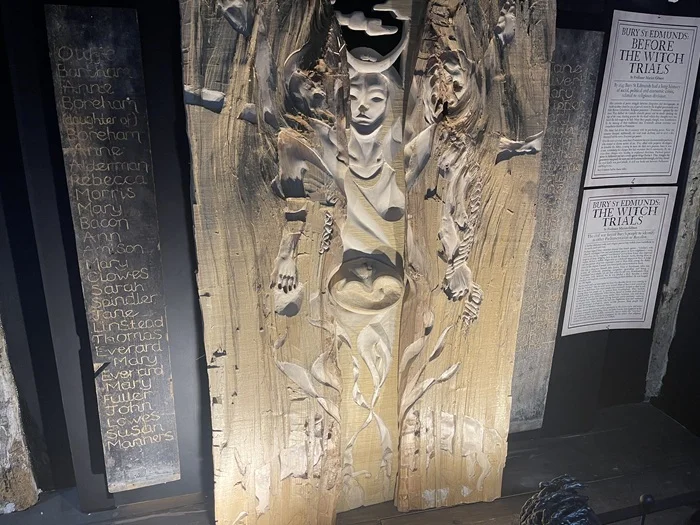

Bury's first memorial to its witch trial victims, carved from a storm-torn Nowton Park lime, is now on show at Moyse's Hall. A trial play follows in February.
Bury St Edmunds now has its first memorial to the people tried and executed in the town for witchcraft. The carved sculpture names every known victim of the town’s witch trials, from 1599 to 1694. It is on permanent display at Moyse’s Hall Museum on the Cornhill.
Updated 31 October: the memorial has been installed at Moyse’s Hall, West Suffolk Council said on 30 October. We have added how it was made and what it shows, and the council’s photographs of it in place.
West Suffolk Council, which runs the museum, announced it on 13 October. The same project will restage one of the town’s real trials, from 1662, at The Guildhall in February.
What the memorial shows
The memorial was designed by Kate Jackson, who is from Bury St Edmunds and was the lead singer of The Long Blondes. She worked with the Bury wood carver John Williams.
It is carved from a damaged lime tree from Nowton Park. Kate Jackson said wood mattered because it was the material of everyday life at the time, and of the scaffold the victims were hanged from. John Williams said they chose sections of the tree that had been “violently ripped apart” by wind, because that “echoed the suppressed violence this memorial needed”.
The design shows women at three stages of life:
- the maiden
- the mother, holding an unborn child
- the crone
Their arms reach upwards out of flames, while the ropes used to hang them hold them back. “It is an image of defiance rather than one of suppression and horror,” Kate Jackson said.
The figures are carved in reverse, as hollows cut into the wood. John Williams said that makes the faces appear to follow visitors as they walk past, an illusion known as the hollow mask effect.
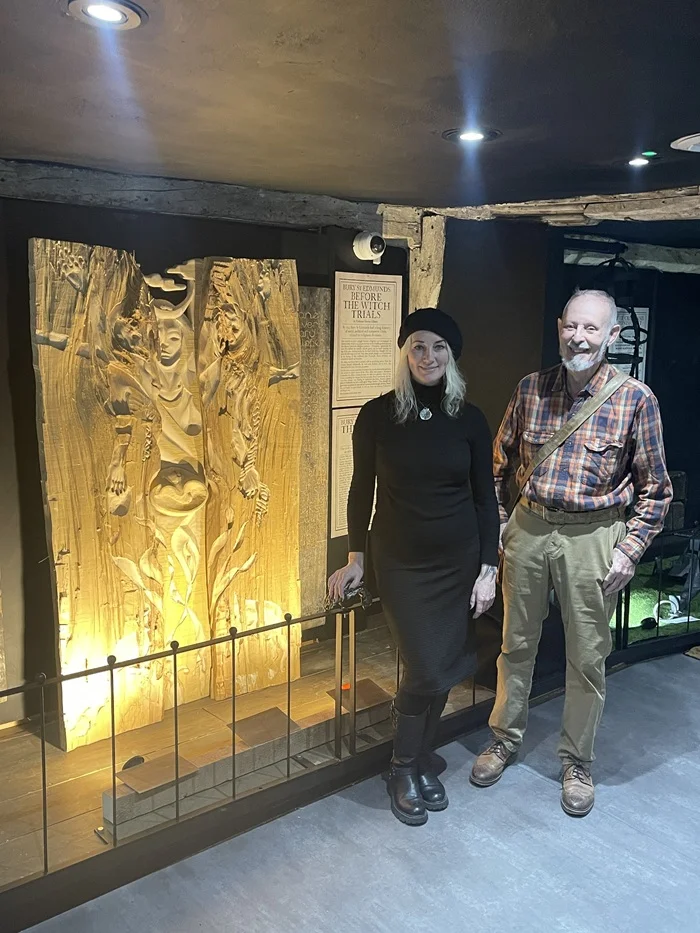
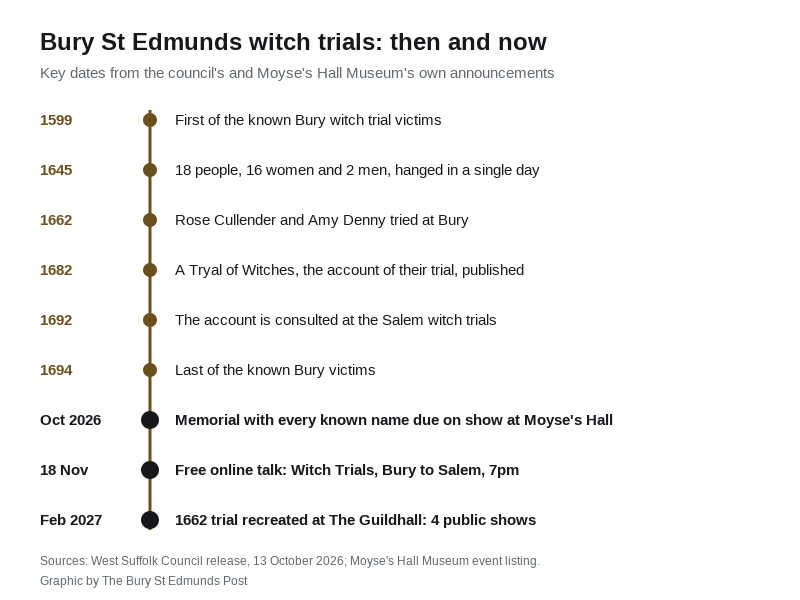
Among the names it will carry are the 18 people hanged in a single day in 1645: 16 women and two men, one of them a vicar. The council says they were among some 140 people from all over Suffolk who were rounded up and brought to Bury by cart for trial.
The 1662 trial, and why it mattered beyond Suffolk
Rose Cullender and Amy Denny (spelt Duny in the records of the time) were tried at Bury in 1662. According to the council, their trial was the first accepted use of “spectral evidence”. That is testimony that the accused’s spirit had appeared to and harmed the victims.
An account of the trial, A Tryal of Witches, At the Assizes Held at Bury St Edmunds for the County of Suffolk, was first published in 1682. It was later consulted in Salem, Massachusetts, during the 1692 witch trials there, according to the museum’s event listing. Moyse’s Hall holds a rare copy. The council describes its copy as 310 years old and says the Bury Society helped it buy the book last year.
The trial on stage at The Guildhall
Magic Floor Productions will recreate the Cullender and Denny trial at The Guildhall in Bury in February. There will be four public performances and four more for local schools only.
The company is based in Thetford, about 12 miles north. It already stages trial re-enactments at Thetford’s old assizes court, where the audience sits as the jury, hears the original evidence and decides on a verdict. Dates and tickets for the Bury performances are not on its show diary yet.
Who is paying
- The Bury Society has put in more than £15,000, covering both the sculpture and the Guildhall performances.
- The Friends of Moyse’s Hall Museum have given £500.
- West Suffolk Council is paying for new display panels in the museum’s Crime and Punishment section, and for their long-term care.
Cllr Ian Shipp, the council’s cabinet member for leisure and culture, said: “What happened in Bury St Edmunds was a part of that dark and brutal history and shouldn’t be forgotten.”
Terry O’Donoghue, chair of the Bury Society, said the performances were “an opportunity to highlight how playing on insecurity, fear and jealousy, can lead to shameful, tragic consequences”.
Dr Steve Jones, secretary of the Friends of Moyse’s Hall, said attention usually falls on the witch finders rather than the people they accused. “This project aims to redress the balance by concentrating on the so-called witches: their lives and experiences,” he said.
What it means for you
- To see the memorial: Moyse’s Hall is open 10am to 5pm Monday to Saturday (last entry 4pm) and 10am to 4pm on Sundays (last entry 3pm), according to its visit page. A day ticket is £5.50 for adults and £4 for children and students, and under-5s are free. The £15.50 Heritage Ticket covers a year at Moyse’s Hall and West Stow.
- The memorial sits with the museum’s crime and punishment displays. The same ticket covers the Halloween exhibition, Things that go bump, and Edmund and the Great Heathen Army.
- A free online talk, Witch Trials: Bury to Salem, runs on Zoom at 7pm on Wednesday 18 November. Moyse’s Hall’s heritage officer and the Salem Witch Museum’s director of education will each show an exhibit live from their museums, with a Q&A. Details are on the museum’s listing.
- For the February performances, watch Magic Floor Productions’ show diary. We will add the dates here when they are published.
More things to do in town are in our Bury St Edmunds guide.
Have your say